Weekend Long Read: Fire District Budget Passes as Williamstown Talks Local News
Welcome back to the Weekend Long Read. This week we're doing things a little differently.
Our format is usually one big topic, but we've got some catching up to do — and a genuinely big idea to dig into — so we're splitting the difference. First, we'll give you a recap of last Tuesday's Williamstown Fire District Annual Meeting, which we weren't able to cover when it happened. Then we'll get into our "Big Topic Made Local." This week we'll be looking at the health of civic discourse and local news, and what a recent gathering at the Milne Public Library had to say about it.
On the WIlliamstown calendar this week, there is one public meeting to flag:
BART Board of Trustees
Wednesday, June 3, 6–8pm
1 Commercial Street, Adams, MA
Hybrid — in person or via Zoom (meeting ID: 924 7216 3095; dial-in: 646.931.3860)
The agenda includes the Executive Director's year-end report, finance and audit, and governance — including a vote on a slate of board officers and end-of-year awards.
One more thing before we get into it: a well-deserved shout-out to our Youth Correspondent Jack Uhas, who recently received the Supporting Democracy Leadership Award from the Williamstown League of Women Voters.
Jack is going to be covering the next school board meeting, where a budget vote on funding for a math interventionist is expected to be on the agenda. That's shaping up to be a lively one, and we're glad to have him on it. Keep an eye on your inbox for his report.
Town Business: Williamstown Fire District Holds Annual Meeting
The Williamstown Fire District held its 2026 Annual Meeting on Tuesday, May 26, at the Williamstown Elementary School gymnasium.
Election of officers opened the evening. Michael Noise won the open seat on the Prudential Committee. Paul Harsch was elected Moderator with 16 votes.
Prudential Committee Chair Dave Moresi opened the business meeting by calling the past year a milestone year for the district — a new fire chief, a new fire station, and a public open house at the new station held May 30. Moresi praised the department's volunteers for their work through the transition. The meeting also recognized John Notsely, who has served on the Prudential Committee continuously since 1963.
On Article 6, which authorized the Prudential Committee to convey or sell the district's former fire station property at 34 Water Street, one attendee asked whether there had been interest in the space. Moresi noted the district had been waiting for the vote before moving forward — significant interest has already been expressed, and the district can now proceed with disposition of the property.
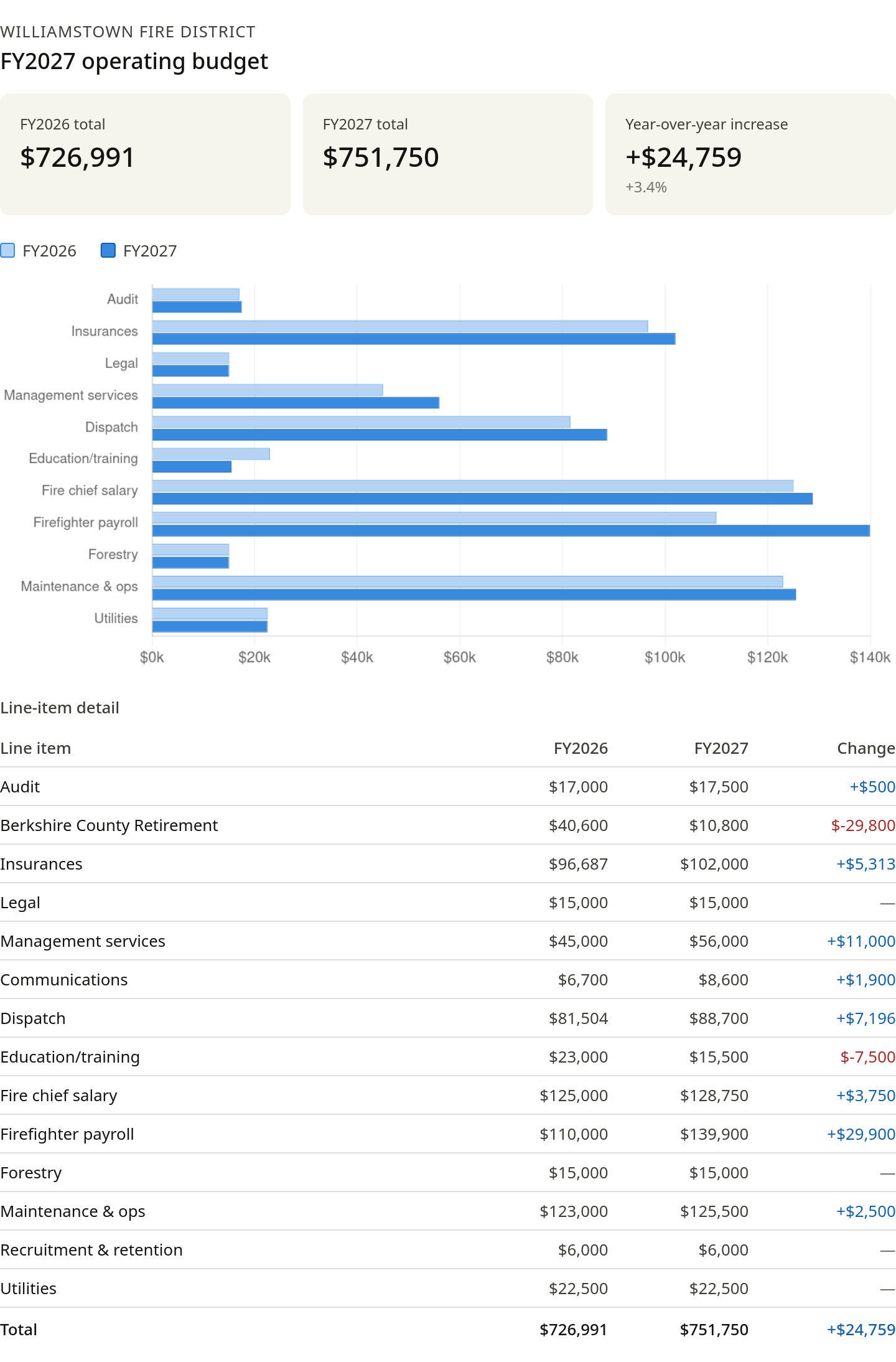
All remaining articles — covering the FY2027 operating budget of $751,750, a $100,000 reserve fund, $80,000 for equipment replacement, $380,000 toward the balance owed on a new Toyne fire pumper, $1.72 million in bond payments for the new station, $83,000 for a pickup truck, and several housekeeping items — passed unanimously. The meeting adjourned without further business.
Big Topic Made Local: Does the Greylock Region Have a Healthy News Ecosystem?
If the Fire District meeting was a reminder that local government still runs on people showing up in person, the library gathering the next day asked the next question: how do residents even know what to show up for?
The gathering, organized by Citizen Media Inc. under the title Finding Community: News, social media and the new town squares, drew neighbors, local information-sharers, and the curious. It was less a panel than a circle — people taking turns introducing themselves and then, almost immediately, getting to the point.
The mood was not apocalyptic, but it was honest. A lot of local news has disappeared, people noted. Third places — the coffee shops, civic clubs, and gathering spaces where information once moved informally — have thinned out alongside the mastheads. Social media has not replaced them so much as created the illusion that something has replaced them: a stream of posts, comments, and group threads that can feel like civic conversation without necessarily producing shared understanding.
One thread of discontent was very concrete: residents said they often don't know about public meetings until it's too late to participate meaningfully, and that when boards hold divided votes, the public rarely learns why members split or what was actually in tension. That opacity, several people felt, makes local government harder to understand and harder to hold accountable.
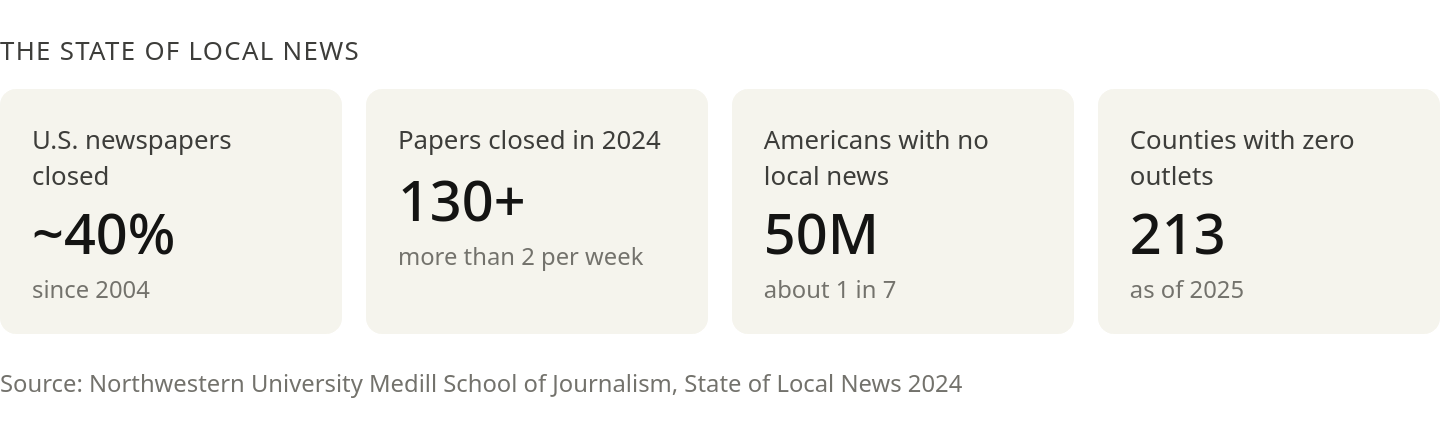
These aren't just local feelings. Northwestern University's Medill School of Journalism has been tracking local news closures since 2016: nearly 40% of all U.S. newspapers have vanished over two decades, more than 130 closed in 2024 alone, and roughly 50 million Americans now live with limited or no access to reliable local news.
The Knight Foundation, which has invested hundreds of millions in local journalism, finds that healthy ecosystems require not just multiple outlets but a "backbone" institution actively keeping the network connected — and that weaker news systems correlate directly with lower voter turnout, more government corruption, and greater community alienation.
Author and tech critic Cory Doctorow adds another layer: the platforms communities migrated to as local news shrank have themselves decayed through what he calls "enshittification" — the predictable cycle by which platforms serve users first, then advertisers, then only themselves, leaving the civic conversation that moved onto Facebook and Twitter scattered and harder to find than ever.
In some ways, the northern Berkshires are lucky. Yes, we have the Berkshire Eagle and iBerkshires, but we also have Greylock Glass, originally started as an arts and culture blog and now moving into the heavy lifting of long-form investigative writing; Greylock News, run by Bill Densmore; WilliNet, which films virtually all of our public meetings and makes them available to watch for free online — an invaluable primary source that many communities simply don't have; a Select Board member in Steph Boyd who regularly holds coffee hours to talk with constituents; and even the humble little Civics Corner. That's more than a lot of communities our size can say.
But the question remains: how do we properly support these resources? How do we leverage them? How do we ensure that committed independent journalists — like Kate Abbott, whose reporting was invaluable in covering the proposed Notch Forest Project — are supported, and that residents actually know about and use what exists?
At Civics Corner, we've been thinking hard about this — and specifically about how to leverage our Town Meeting government to move things from "it would be nice" to "we can actually make this happen." We are lucky enough to live in a town where just 10 signatures on a Citizens Petition gets you a vote at Town Meeting, attended by around 300 people, where small organized voting blocs can make a real difference. Here are three concrete proposals. We'd love to know what you think.
1. Require plain-language explainers for all Warrant Articles
Warrant Articles are written in legal language, and for good reason — they are legal documents. But there is no reason the town couldn't also produce a plain-language explainer alongside each item: what it does, what it costs, what happens if it passes or fails.
We did our homework on how to actually make this happen. The cleanest first step would be a non-binding resolution at Town Meeting asking the Select Board to adopt plain-language explainers as standard practice. A resolution requires no approval from the state Attorney General's office — it's a strong public signal, but boards could technically ignore it.
A binding bylaw amendment would be enforceable, but there's a relevant precedent: when Stoughton tried to use a bylaw to require its Select Board to hold a public comment period, the AG struck it down, ruling that Town Meeting cannot legislate how boards conduct their own meetings.
Any binding version would need careful legal drafting — attaching it to the warrant preparation process rather than to board conduct — and a conversation with Town Counsel first. But starting with a resolution, building the expectation publicly, and pushing for the bylaw later is a realistic path.
2. Require transparency on split votes
At the 2025 Town Meeting, a citizen directly asked the Select Board to explain why they had split on a CPC-funded vote. Then Select Board Chair Jane Patton's response was, essentially, "watch it on WilliNet." That may have been technically true, but it was not especially useful in the moment, when residents were being asked to vote. The Town Moderator then informed the meeting that the Select Board could not be compelled to explain themselves.
We went back and watched the relevant WilliNet recording. When the Select Board vote split on that CPC item, the members who voted against it offered no explanation. So yes, we have WilliNet. Yes, we have the Open Meeting Law. And yes, our Select Board members are volunteers doing hard, time-consuming work. But residents deserve to know the reasoning behind split votes before they're asked to act on them at Town Meeting.
The same Stoughton precedent applies here: binding a board to explain itself through Town Meeting bylaw is legally difficult.
The more achievable path is a non-binding resolution combined with sustained public pressure — and frankly, just showing up and asking the question directly, as that citizen did in 2025. The ask itself has value. We'd also suggest pairing this with proposal 1: when a board recommendation is split, the plain-language explainer should say so and briefly summarize the competing views. That's arguably within scope of the warrant preparation process rather than board conduct, and more likely to survive legal review.
3. A volunteer community reporter corps
This one requires no Town Meeting vote and no AG review — just people willing to show up. The library meeting felt like a natural seed for it: a small group of people who care, already in the same room. The next step could be as simple as agreeing to meet every couple of weeks, sharing story ideas, and covering the meetings and institutions that aren't currently being covered.
There's a useful Massachusetts model: the Bedford Citizen started as three League of Women Voters members who had been monitoring local government and decided to simply write it up for the public. Over the years it grew from an all-volunteer operation into a professional nonprofit news organization. We're not suggesting Williamstown needs to replicate that overnight — but the starting point is the same: a small group of people, a consistent cadence, and a shared commitment to showing up. If this is something you'd want to help organize or be part of, let us know at hello@civicscorner.org.
What comes next is up to you.
The three proposals above aren't complicated. They don't require a grant or a new organization or a charismatic leader. They require residents who care enough to show up, sign their name, ask an inconvenient question, or simply read and share the local reporting that already exists.
As for us: we're going to stay in touch with the connections we made at the library last week, and we hope to be part of a collective effort to keep the Berkshires a healthy civic ecosystem. We'll keep you posted on what that looks like.
In the meantime, let us know what you think at hello@civicscorner.org.
Member discussion