The Weekend Long Read: What Are All-Party Primaries, and What Could They Mean for the Berkshires?

Welcome back to the Weekend Long Read. A couple of housekeeping items before we jump in.
Last week was All Town Meeting, and since then a lot of people have reached out with questions and thoughts on things they'd like to see change. We're working on a future Weekend Long Read that takes more of a Q&A format and tries to address some of those directly — but to do that well, we need to hear from more of you first. If you have thoughts on Town Meeting, ideas for how it could work better, or specific questions you'd like us to try to answer, please send them our way.
Second, Greylock News is hosting an event at the Milne Public Library in Williamstown this Wednesday, May 27, from 6:15 to 7:45 p.m. The topic: "Finding Community: News, Social Media and the New Town Squares." It's a public, open conversation about how we stay connected as local communities in the digital age.
We'll be there and would love it if you stopped by.
Ok, jumping back into this weekend's topic!
Today we're tackling something that sounds procedural but is, at its core, a pretty fundamental question about how democracy works: party primaries. A ballot initiative is working its way toward Massachusetts voters this November that could change how every state and federal election in the commonwealth is decided — and if it clears its remaining legal hurdles, it's going to have a very concrete answer. Let's take a look at what's being proposed, why it's become one of the more contentious political debates in the state, and what it could mean for voters here.
The Problem Reformers Are Trying to Solve
For most of American history, political parties chose their candidates internally — through conventions and backroom deals among insiders. The Progressive movement changed that in the early 1900s, pushing to let ordinary voters choose nominees directly through elections. The system spread quickly, and what we use in Massachusetts today is a direct descendant: registered party members vote in separate primaries to pick their nominees, who then face off in November. [1]
That structure has held for over a century. But there is some strong evidence that it just isn't working for us anymore. In Massachusetts, most legislative and congressional districts lean so heavily toward one party that the primary — not the general election — is the race that actually decides who holds office. Win the Democratic primary in a blue district, and you're almost certainly going to win in November. The general election, the one where all voters can participate, is often a formality.
That would be fine if everyone could vote in the primary. But they can't. Registered Democrats vote only in the Democratic primary. Registered Republicans vote only in the Republican primary. Unenrolled voters — what Massachusetts calls independents — can request a party ballot, but they have to pick one, which means they're locked out of the other party's races. [2]
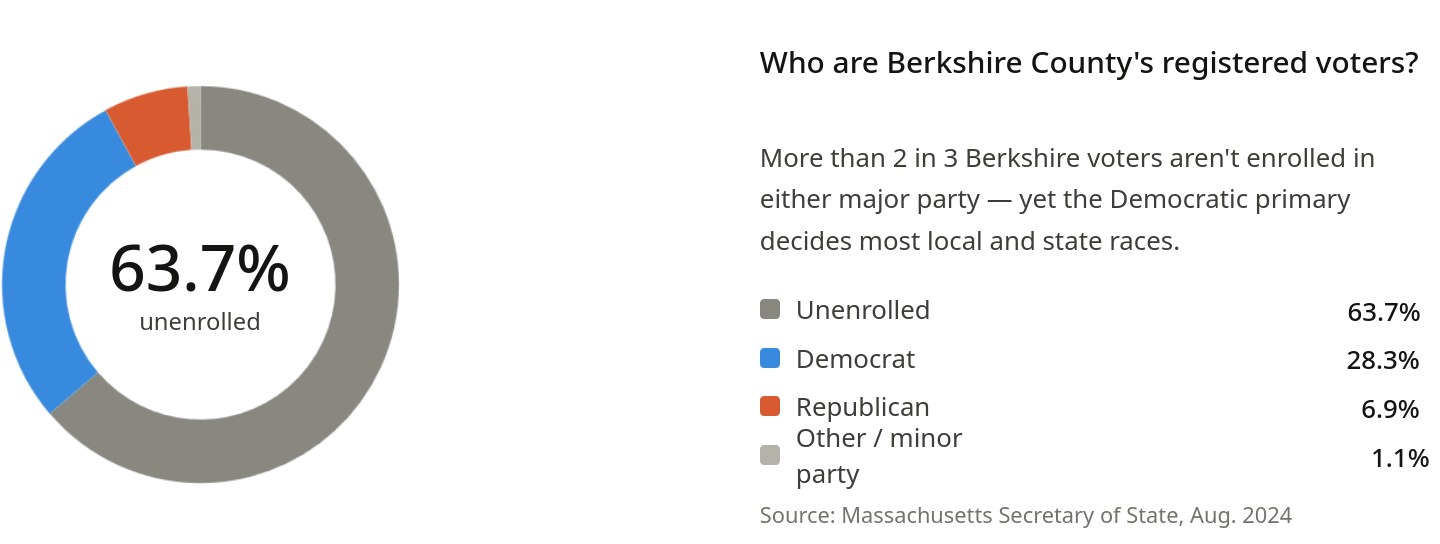
In Berkshire County, as of 2024, roughly 63.7 percent of registered voters are unenrolled — more than 63,000 people out of approximately 99,000 total. [3] Statewide, the figure is about 65 percent, making unenrolled voters the single largest bloc in Massachusetts, outnumbering registered Democrats and Republicans combined. [4]
In 2024, Ballotpedia named Massachusetts home to the least competitive state legislative elections in the country. Half of state legislative races over the past decade had only one candidate on the ballot. [5]
A Nationally Watched Test Case: Kentucky, May 2026
This past Tuesday, Kentucky's 4th Congressional District gave us a near-perfect illustration of what this problem looks like in practice.
Rep. Thomas Massie, a libertarian-leaning seven-term Republican incumbent, lost his primary to Ed Gallrein, a farmer and former Navy SEAL recruited and endorsed by President Trump. The contest became the most expensive U.S. House primary on record, drawing more than $32 million in ad spending. [13] One political scientist at the University of Kentucky put it plainly: "Massie's defeat sends the clearest message yet that the Republican Party is Donald Trump's party." [14]
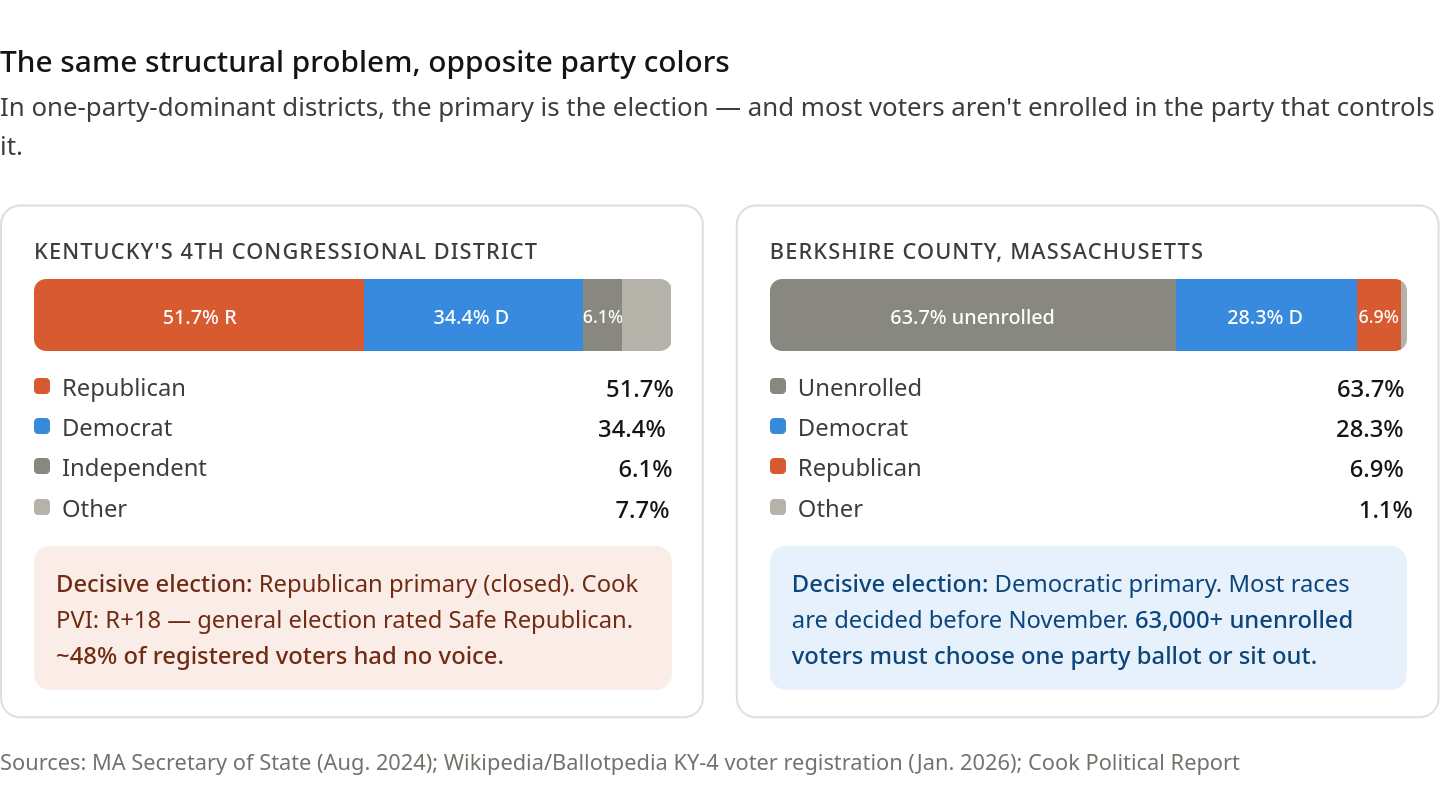
Here's what matters for our purposes. The Cook Partisan Voter Index for the district is R+18 — it votes 18 points more Republican than the national average. Every major forecaster rated the November general election Safe or Solid Republican before the primary even took place. The primary was, in effect, the only election that mattered. And who got to vote in it?
Of the district's roughly 597,000 registered voters, about 52 percent are registered Republican, 34 percent Democrat, 6 percent independent, and 7 percent in minor parties or "other." [15] Kentucky uses a closed primary system. The nearly 48 percent of registered voters who aren't Republican had no access to the election that will decide who represents them.
In his concession speech, Massie told the crowd: "There is a yearning in this country for someone who will vote for principles over party." He also called for a "unity party." A unified primary — one where all those 287,000 non-Republican registered voters could have cast a ballot — is precisely what the Massachusetts initiative would create. Whether it would have changed the outcome in Kentucky is unknowable. What is knowable is that under the current system, those voters weren't asked.
The Proposal: What an All-Party Primary Would Actually Do
The Massachusetts All-Party Primary Elections Initiative, officially Initiative 25-12, would replace separate party primaries with one unified primary ballot for each race. Every candidate, regardless of party, would appear on that single ballot. Every registered voter would participate. The top two vote-getters advance to November, regardless of party affiliation. [6]
Party affiliations would still appear on the ballot next to candidates' names, and parties could still endorse candidates. But the primary itself would be a single open contest rather than a series of parallel party elections. [6]
This means that in heavily partisan districts, two candidates from the same party could advance to the general election — two Democrats in a blue district, two Republicans in a red one. Supporters believe this would give the full electorate a meaningful choice in November rather than handing the decisive vote to a small primary base. Critics see it differently, and we'll get to their arguments. The initiative would cover state House and Senate races, statewide offices like Governor, and U.S. House and Senate races. Presidential primaries would not be affected. [6]
Worth noting: Massachusetts already runs every city and town election — mayors, city councilors, school committees — as a nonpartisan top-two contest. Nobody calls those elections radical. The initiative would extend that same model to state and federal races. California, Washington, and Alaska have adopted versions of this system at the state level. [7]
Who Is Championing It, and Why
The campaign is led by the Coalition for Healthy Democracy, whose convening chair is Danielle Allen, a Harvard professor of political philosophy and founder of several civic organizations. [8] The coalition is explicitly bipartisan — Jennifer Nassour, a former chair of the Massachusetts Republican Party, appeared alongside Allen at the campaign's December 2025 State House rally, when organizers delivered approximately 80,000 signatures to the Secretary of State's office. [9]
Allen's core argument is about accountability: when unenrolled voters are shut out of the elections that actually decide representation, elected officials have less reason to listen to them. "When voters are taken for granted, accountability slips and urgency disappears. When urgency disappears, problems linger." [4] The NAACP Berkshire County Branch has also voiced support, arguing that communities of color — who are disproportionately unenrolled — would gain a fuller voice under the reform. [10]
The Other Side: Arguments Against the Reform
The opposition is coming from both parties, and the arguments deserve to be taken seriously.
The Massachusetts Democratic State Committee voted in April to formally oppose the initiative. Two Democratic State Committee members filed a lawsuit with the Supreme Judicial Court arguing it places an unconstitutional burden on the right to vote by limiting the general election ballot to two candidates. The SJC heard arguments this spring. [11]
Progressive activists have raised a practical concern: money. When a primary is open to all voters rather than filtered through a party, name recognition and fundraising matter more. Critics point to California's experience, where wealthy self-funded candidates have sometimes dominated top-two primaries, arguing the reform could tilt elections toward candidates with large war chests and make it harder for community-rooted candidates to compete. [12]
On the Republican side, MassGOP chair Amy Carnevale has argued that the existing system ensures voters can choose between "two alternative political philosophies." In a state where fewer than seven percent of voters are registered Republican, the party has additional reason to be wary: in heavily Democratic districts, two Democrats could advance to November, leaving Republican voters without a candidate from their party. [11]
Some critics also note that the evidence on top-two primaries is mixed — research on whether they reduce polarization or increase turnout has been inconsistent. A Boston Globe opinion piece this month argued that Massachusetts has already elected moderate and outsider candidates like Elizabeth Warren, Charlie Baker, and Ayanna Pressley without reforming the primary system, and that the real problem lies in the structure of the state legislature. [12]
Supporters counter that the goal isn't to change who wins — it's to change who decides. Shifting the decisive vote from a small primary base to the full November electorate is the point, even if outcomes look similar in many races.
What Does This Mean for Berkshire County?
Berkshire County has something concrete at stake here.
The numbers: 63.7 percent of registered voters in the county are unenrolled. In Clarksburg, the share is about 74 percent. Only 6.9 percent of Berkshire voters are registered Republican. [3] That means the Democratic primary decides most local and state races covering Berkshire — and in that primary, the county's 63,000-plus unenrolled voters have to choose between picking up a Democratic ballot (and forfeiting any Republican races) or skipping the primary that actually matters.
The Kentucky race is a useful mirror. Berkshire County's situation is the inverse — deeply blue rather than deeply red — but the structural problem is identical. Most voters are locked out of the decisive election. The party that dominates the district controls access to the contest that matters. The full electorate only gets to weigh in after a smaller subset of enrolled partisans has already decided.
Under an all-party primary system, all of those voters would simply vote — in one primary, for any candidate, in every race. In a county where uncontested races have become routine, that alone could change the texture of local democracy.
Where Things Stand Right Now
The path to the November 2026 ballot is not yet clear. The campaign still needs to collect roughly 12,400 additional certified signatures and file them by mid-June. The SJC lawsuit remains pending. If the court allows the question to proceed and the signature threshold is met, Massachusetts voters would decide in November. An Emerson College poll found roughly half of surveyed voters support changing the primary system — suggesting the question would be competitive if it reaches the ballot. [11]
The Bottom Line
Electoral reform is easy to tune out. The mechanics of primaries feel distant from our daily concerns. But the question at the center of this debate remains important. If two candidates from the same party end up on the November ballot, does that actually force the party to be more competitive and more responsive to what voters want? And does it make it harder for an extremist to win simply because they were the only name from their party in the general election — not because a majority of voters actually wanted them there?
Kentucky's 4th District just answered that question in stark terms. Over $32 million was spent influencing the choices of roughly half the district's registered voters, in an election the other half couldn't participate in, for a seat that effectively can't be flipped in November. You don't have to have an opinion on Thomas Massie or Ed Gallrein to see the structural problem that story illustrates.
Whether an all-party primary would actually improve things — or introduce new problems around money, party accountability, and voter choice — is a genuine debate. What's not in dispute is that in a county where nearly two-thirds of voters aren't enrolled in either major party, the question of who gets to vote in the elections that matter most is not an abstract one.
Keep an eye on the SJC's ruling and the signature deadline this June. In the meantime, learn more at the Coalition for Healthy Democracy's website, or review the official initiative text through the Massachusetts Attorney General's office.
Sources
[1] Britannica, "Direct Primary." https://www.britannica.com/topic/direct-primary
[2] CBS Boston, "Who Can Vote in the Massachusetts Primary?" https://www.cbsnews.com/boston/news/who-can-vote-in-the-massachusetts-primary-2024/
[3] Massachusetts Secretary of State, "Registered Voters and Party Enrollment as of August 24, 2024." Berkshire County: 99,087 total registered voters, 63,146 (63.73%) unenrolled, 28,070 (28.33%) Democrat, 6,820 (6.88%) Republican. https://www.sec.state.ma.us/divisions/elections/download/research-and-statistics/enrolment_count_20240903.pdf
[4] Ballotpedia, "Massachusetts Top-Two Primary Elections Initiative (2026)." https://ballotpedia.org/Massachusetts_Top-Two_Primary_Elections_Initiative_(2026)
[5] Coalition for Healthy Democracy FAQ. https://coalitionforhealthydemocracy.org/frequently-asked-questions/
[6] Coalition for Healthy Democracy, "MA All-Party Primary Reform." https://coalitionforhealthydemocracy.org/
[7] Coalition for Healthy Democracy, "Jungle Primary Massachusetts? No — Here's the Difference." https://coalitionforhealthydemocracy.org/jungle-primary-massachusetts/
[8] Civics Corner, "Democracy Starts Locally" (May 7, 2026). https://civicscorner.com
[9] State House News Service/WWLP, "All-Party Primaries Seen as 'Changing the Incentives'" (December 1, 2025). https://www.statehousenews.com/news/politics/elections/all-party-primaries-seen-as-changing-the-incentives/article_e4b96748-6825-4181-830b-32759aab92de.html
[10] Civics Corner, "Democracy Starts Locally" (May 7, 2026). https://civicscorner.com
[11] The Boston Globe / Hoodline, "Massachusetts Democrats Clash Over All-Party Primary Plan" (May 2026). https://www.bostonglobe.com/2026/05/11/metro/party-primaries-ballot-question-democrats/
[12] Boston Globe Opinion, "The Case Against an All-Party Primary in Massachusetts" (May 6, 2026). https://globeopinion.substack.com/p/all-party-primary-massachusetts-undermines-democracy
[13] Washington Post, "Thomas Massie Loses to Trump-Endorsed Ed Gallrein in Kentucky GOP Primary" (May 19, 2026). https://www.washingtonpost.com/politics/2026/05/19/thomas-massie-faces-ed-gallrein-kentucky-gop-primary-with-massive-spending/
[14] TIME, "'The Clearest Message Yet': Massie's Primary Defeat Underscores Trump's Hold on the Republican Party" (May 19, 2026). https://time.com/article/2026/05/19/massie-trump-kentucky-house-republican-primary-gallrein/
[15] Wikipedia / Ballotpedia, "Kentucky's 4th Congressional District." Voter registration as of January 1, 2026: 51.74% Republican, 34.43% Democrat, 6.10% Independent. Cook PVI: R+18. https://ballotpedia.org/Kentucky's_4th_Congressional_District_election,_2026
Member discussion